This is continuation of last year's summary of my thoughts on a subject of a digital camera and its future.
First of all, I'm not writing about a camera I recently parted with, because I didn't. Even more, with holiday season coming I was on a lookout for something (GAS, you know...), but struggled to see an object that could be of a valuable addition and/or replacement to one of currently owned devices. So FZ1000 is definitely safe, with its versatility, more than satisfying image quality, very good handling and option for 4K. Then there is Olympus 12-40mm f/2.8 lens: with its sharpness uniformity having no contender amongst other systems and lovely contrast, it makes the perfect day-to-day piece of glass. Atached to E-M1 body it balances well, and this camera was the first I managed to complain that it offers too many direct access buttons (to be fair, only after using the lever) and needs refreshment course in operation once not used for longer. Then there is E-PM2 - as good image quality as any other MFT body in as little as not many package, with equally diminutive Panasonic 45-150/4-5.6 complementing range of angles of view. Last, but not least, the beast: Nikkor VR 70-300 mm f/4.5-5.6 on Nikon V1 body.
So what happened? Quality of images produced by these cameras (except for V1), in typical conditions I photograph (outside, daylight, no rain) and typical output being WQHD (2560x1440) display or 1000px wide export for web is sufficient for me. Full stop. I occasionally find challenging conditions, but not often enough to justify foray into large sensor teritory. Operation of the cameras I own, even though not free from quirks, is also satisfying (Nikon excluded). In the current market climate there are not a lot of objects desirable enough to reach to the pocket.
What is currrent market in my opinion then? Most of all, progress in sensor sensitivity improvement slowed down, so new generations of cameras aren't much different than what they replace. Changes seem to be focused mainly on polishing operation ergonomics (which is great!), but that hardly justifies price tag coming with 'just released' being actually 'mild facelift'. But it definitely is great market for buyer, with cameras perfected in their n-th generation, and old-but-as-good-as-new models available for a fraction of price asked 2 years ago: E-M5, which still is a great piece of equipment (see reasons above), can be had new for £349. With new models inevitably coming, that pushes even greater pressure on the market, and soon its players will need to adjust. One already seemed to have found a solution: Sony uses its lead in sensor manufacturing as well as innovation in camera forms and capabilities and focuses on the upper end of price brackets. Canon and Nikon do their usual (not a lot). All the rest try to innovate, but the scale of sales is against them.
What might happen?
This is a speculation based on my observation of digital imaging devices market and my experience with some of those devices. I started editing this post come time ago, and so the opinions were evolving, rather than being a snapshot of the current state.
Again I'm going to divide into specific areas, and refer to the previous 'forecast'
4K - quite surprisingly, Ultra High Definition TV receivers seem to be selling well, so the gap created by the lack of content will help leverage adoption of 4K recording in digital cameras even more.
8K - wooah, not too fast? Maybe not - since 4K painfully paved way for the underlying technology, 8K actually isn't that far away. Its advantage is obvious : 8K=4*4K . Simples ;) But most of all Sony new 42Mpix sensor is exactly that: 7952 x 5304 easily cropped to 7680×4320. Easily downsampled to 4K. Or heavy cropped to 4K. Take your pick.
I hoped to see the end of megapixel war, and even though Canon had to breach 50M barrier, the main player seems to be more pragmatic: use as many sensels as it is really needed, and only so many so reading them fast is not more challenging that required. The slight bump in pixel count from current best 36Mpix (7380 x 4928 - just shy of 8K) over the same surface should be offset by using BSI structure.
C'mon, it was supposed to be about photography, wasn't it? Well, I feel this is where the biggest shift is going to happen: with 4K, and more so with 8K, having 24/30fps with so many details will cause traditional 'still' approach to be greatly reduced. With serious consequences.
Stabilisation - back in the stills domain for a moment, spatial resolution of the sensors became so high, that any minute movement causes image to be blurred at pixel level. To the extent that electronic first curtain shutter of Nikon D810 is the most notable upgrade of that model versus D800, and good enough reson for many to switch. Sony A7RII headline feature is 5-axis IBIS, greatly expanding its shooting envelope. With video good stabilisation is even more crucial, as with affordable readout methods pretty much limited to rolling shutter only (I'd love to see some clever mechanical video shutter one day, unless stacking methods finally enable global shutter for masses), so jello and all other forms of vibration are big enemies. With advent of drones and their gimbals, it seems obvious this technology will filter into recording devices. Or upscale from current mage stabilisation systems. And so the video will be still :)
Form - naturally digital still image camera grew on legacy of film, and so video recorders came from studio boxes. Yet nowadays they share the same key components, and their functionality overlaps more and more. Surely, many will remain as their specific specialized form suits well in many cases. But as still/video will blend, the form will ivevitably morph as well.
So let's talk about film SLR: it needs space for a roll of the film, space to expose it, space to collect it, a lever actuated with the right thumb to transport it and a hump housing a prism right on axis with the lens.
Now let's talk about digital mirrorless camera: it doesn't need space for the roll of the film to the left of the lens, it doesn't have to use vertical form of grip because thumb is relieved from duty and neither EVF needs to sit right above the lens (luckily in this case designers can peek at rangefinders and place it in the top left corner of the body). The point is, as much as retro is visually attractive (by being reminiscent?), it actually acts against the ergonomics of a camera: if holding it is as unnatural as a smartphone when taking a photo, isn't that another point against having dedicated device? Cameras keep downsizing, there is less and less room for fingers of the right hand to hold on to, yet the lens does not shift to the left to regain some space. No, there must be 'traditional' chunk of chassis which whole purpose is to cut into left palm supporting the lens. And of course there must be no good grip: cameras 20 years ago didn't have one, so why would you want such comfort today? As much as I can understand that approach for pocketable models with fully collapsible lenses, in case of bodies with interchangeable lenses it is obvious that the glass this is going to be the most protruding part of the combination, so adding decent grip will not make the eventual setup any thicker! And that grip can house bigger battery, more controls or whatever sits to the left from the lens.
Traditional form is terrible when it comes to space: its T shape means that most of the volume of a box around is wasted. Also weight distribution (biased to the left and front - where the lens is) causes handling issues and contributes to blur at exposure (shutter press movement, lens front drop).
Alternatives? Handycam-like: weight supported by lying on the thumb, rather than squeezed, better weight distribution (mostly front-back balance), possible to hold with both hands and use EVF, more useful surface for controls, more efficient use of volume (lighter and smaller device).
Some experiments in that field can already be seen (Canon XC10)
Modularity - in some respects extension of the form. Once controls and preview are detached, by using external modules (smartphone, field monitor, VR headset maybe) then only a box housing sensor, storage, battery and electronics is needed. Potenitally can be wrapped into adaptor with viefinder/controls to become more traditional device if required. Or attached to some handy gimbal. Still to gain traction, but some devices already popping up (Blackmagic, DJI Zenmuse X5, DxO One)
External controls - There was no breakthrough in that field over the last year. There is however one thing I would be happy to change my opinion about: focus point selection method. I suggested a solution that would improve manual focus point selection, as use of 4-way controller is not an optimal method. But seeing excitement about capabities of autofocus of new Sony cameras, I'm happy to vote for this road of improvement. After all, purpose of automation is to speed things up and make more reliable at the same time. If AF can select the right subject as fast (or faster) than fidling with D-pad, and on top of that track it - I'm in. Moreover, it does not require any new fancy controls I suggested (4-way around shutter button, next to lens, on the lens?) and still allows for manual selection, should a photographer or conditions require that. By extension, this can be, and is, applied to many other settings. So my viewpoint now is: why some of those controls are still required, and the unfortunate answer is: because automatic setings are often rubbish. So I'm looking forward to reduce number of buttons by improving functions of intestines.
Internal controls - IoT seems to be the buzzword of today, chips in mobile phones gain more procesing power that supercomputers in XX century, their software reacts on touch, voice, shake and location of the device. And then there is ringfanced world of cameras, where tethering is big halo, redefining function of a button impossible, menus crippled by ergonomic idiots (they can be ridiculous)/sadists (they infuriate users)/psychos (one must be out of mind to complicate simple things so much). It is not all doom and gloom though: Panasonic figured out yet another use of 4K video, employing it into post-focus function. Similarly, Olympus managed to add in-camera focus stacking to their products. The list of missing features is still long: as much as I love the idea of OLED depth of focus display on Zeiss Batis lenses, I cannot quite figure out why none of the cameras offer such function on their displays.
So what is going to happen to digital cameras? In short term major driving forces seems to be:
- rolling of backside illumination process across all formats. That will reduce influence of sensor size to total light collecting area (low light sensitivity) versus required/achievable depth of field
- increase in sensel count to 4K/8K, increase in readout speed
- increase in processing capabilities
- progress in lens manufacturing: complex aspherical surfaces and use of Fresnel lens being already used. Shape tuning ('liquid lenses'), metasurfaces, computational optics wait round the corner
On a subject of the sensor format, 1" type (13.2x8.8 mm) and full frame (36x24mm) seem to be defining types. The former is significantly more capable than imaging devices in phones and compact cameras, still allowing for miniature (pocketable) devices. The latter, being of size of traditional film frame, making it natural reference. Micro Four Thirds (17.3x13mm) advantages are proportions (4:3) and fact of using common lens mount by more than one manufacturer. APS-C: With pressure from 1" from the bottom and full frame from above, it is endangered. On the other hand this is 'native' video format, so 4K/8K should boost its importance. It seems to be the most popular, but also the most fragmented format, and there will be some victims. I would love to see some steps to avoid that, like Samsung switching to Fuji X mount - imagine 4K video (no luck with Fuji body) with those lovely primes.
Back to Earth to see what changes could happen in my camera bag:
- Nikon V1 - first on the relegation list. Recently introduced Nikon J5 is what V1 should have been and is on the list as a potential target. Unless V4 with newly announced Sony sensor will smash in.
- Nikkor 70-300 VR - there is a patent for Fresnel version, which should make it even lighter. I doubt it shows any time soon, and this being a great lens, little reason to think about switching, except... announcement of PanaLeica 100-400.
- M.Zuiko 12-40 - fantastic lens, nothing comparable seen so far, definite keeper.
- Olympus E-M1 - new sensor and EVF will surely make way to MkII, but will it be enough to upgrade? Not any time soon. New firmware version brings more reasons to keep it.
- Olympus E-PM2 - I love its size, especially considering the potential. Permanently mounted Panasonic 45-150 lens is so-so, but I like the way it renders (warm colours, significant falloff) and do not use this range so often to be a problem. M.Zuiko 40-150/2.8 too large and expensive for my limited use.
- Panasonic FZ1000 - 1. use new Sony sensor, 2. add touch screen, 3. improve EVF (especially optics), 4. fit bigger battery, 5. reduce lens to 300mm reach: that will make it smaller and lighter overall, of smaller diameter and less unbalanced (better handling), 6. add more video pre-set capabilities. Sony RX10II will be in troble as its 1st version.
Showing posts with label gear. Show all posts
Showing posts with label gear. Show all posts
2015/10/06

2015/07/28
Small apple and big orange: Panasonic 45-150mm f/4-5.6 vs Olympus 40-150mm f/2.8
Traditional wisdom suggests to compare apples to apples, and so there are many comparisons, and many more opinions, about which of the two telephoto zoom lenses of both MicroFourThirds (MFT) manufacturers is better: Panasonic 45-150 mm f/4-5.6 or Olympus 40-150 mm f/4-5.6
I happen to use Panasonic lens on Olympus body (E-PM2), and that makes the great mid-range zoom combo, possibly the best in image quality per size/price. I do not complain neither handling of the camera (with this lens it is acceptable) nor the lens itself (heavy vigneting, red-ish color cast), as the range between 100mm - 200mm focal lengths (in 35mm terms) seems to be the least popular for me, and for the wide angle and supertele I have more appropriate tools.
Nevertheless, this lack of popularity might be coming from subconcious feeling not to compose it that range due to inferior output. Because of this lack of importance to improve in telephoto department as well as a bit prohibitive price and most of all the size of Olympus 40-150 mm f/2.8, I've always been lukewarm towards that piece of glass. However when I learnt about Olympus TEST & WOW offer, I was ready for the challenge.

Usually reviews are focused on picking the one from a bunch of comparable products. Challenging results produced by two so different lenses is a different matter: to figure out if an upgrade is worthy. That aspect seems to be missing, so I hope to help folks in similar situation.
Let's start with the most important difference: Oly offers 1 stop more at the short end, and 2EV more light when at the maximum reach. That is a lot of a difference: in case of achievable shallow depth of field and most of all in terms of light collecting ability. That may make a difference between acceptable image and no image. That is the reason it bears 'PRO' badge - it gives greater confidence in succeeding with an assignment. On top of that it is splash, dust and freezeproof, comes with tripod foot and retractable hood. The hood is lovely - it takes no time to extend it, folding for transport is immediate too. The foot is not so lovely: it is built like a tank, but with the lens being front heavy it painfully reminds (if the load of the neck wasn't enough) on the chest what optics is currently attached. It is secured with a nut, and that is located exactly where a palm of left hand supporting the lens is - rubbish (Olympus seems to have devious tradition of locating elements - like neck strap eyelets - so they poke your hand). When loosened, the foot can be spun around the lens, but apart from painted dots helping to align it, there are no detents setting the position at the quadrants of the collar. The foot can be completely removed (turn it to the 'upside down' position and pull towards the lens mount), but then it exposes four small screws - I suspect they are for foot guiding only, but in case they do set optics element I'd rather not touch them. Also without the foot the barrel looks a bit naked - some masking plastic ring would be a nice addition to the kit. Removing saves however quite substantial 121 g of total weight.

Let's finish with the most obvious difference: it is large (in MFT terms). I used to have Panasonic 100-300 mm, but 40-150 mm f/2.8 is in another league. Saying that, its metal build is of very good quality, with hefty feel reassuring that this lens is going last. It does not extend when changing focal length. That for sure helps with sealing agains elements, and explains its length.
A bunch of numbers:
Test procedure
Tripod loaded with a dumbell for extra stability, located indoors, test camera (Olympus OMD E-M1 firmware v3.0) set to ISO200, IS off, single shotwith 0s anti-shock, external cable remote, AF single. Raw images imported to Lightroom 5.7.1 with no settings applied (other than under-the-bonnet lens profiles and default 25/1/25 sharpening. Since all the images come from the same camera, whatever happens here does not matter too much anyway, as the lenses are the only variables). The best of 3 images made at each focal/aperture setting taken for analysis. Pictures exported to jpeg at 90% quality, sharpening to screen - normal. Crops for
side-by-side comparison saved in IrfanView as jpeg at 90%
(different percents than LR) quality. I have no intention nor tools to
produce absolute numbers, just naked eye to subjectively judge which from a
pair of images looks sharper. Taking advantage of the setup, some other lenses occasionally get added to the mix, to see how they cope in such noble party.
40mm
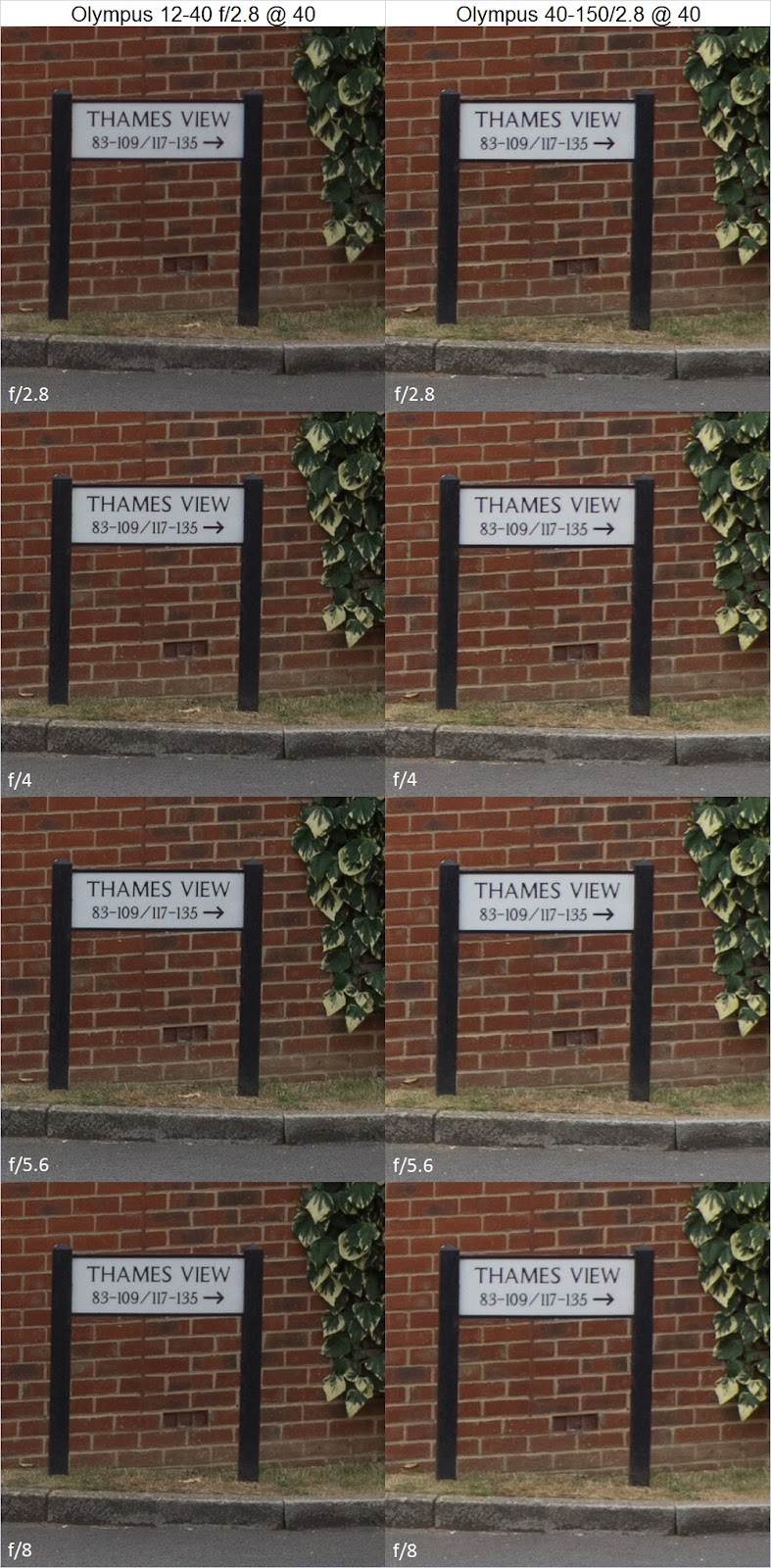
With guest appearance of Olympus 12-40 f/2.8 . Distance to target about 20m, focus (centre point) on the sign. For edge sharpness, focused with rightmost point. That will show the best case scenario, as when focused in the centre, the side will likely be offset (field curvature), although at these depths of field the effect should be negligeble. Click on the images - unless you can already see differences :)


Olympus 12-40 f/2.8 is a bit wider at the long end that 40-150 f/2.8 at its wide setting, so there is some overlap in the system. Both lenses are compromised, being at the end of their ranges, but 12-40 seem to be affected more, showing clearly worse macro- and microcontrast in the centre part. This lens shows some colour fringing evan at f/4, whereas 40-150 seem to be free from chromatic aberration, even wide open. When looking at the side, situation is different: 12-40 is pretty much equally sharp as in the centre (except for soft f/2.8), but 40-150 now loses at each setting, with delicate purple edges at f/2.8 and f/4. So having both lenses Olymous gives a choice: moderate, but uniform sharpness of 12-40 or excellent centre paid for by worse sides in case of 40-150. Light falloff in 12-40 disappears gradually all the way till f/8, in 40-150 is gone by f/4
45mm
Here Olympus 45 f/1.8 joins the party and the real battle between Olympus and Panasonic begins.


Let's start with the lonely prime: at the centre it starts very soft (and at f/1.8 it is much worse!), but at f/5.6 the macrocontrast seem to be in the region of 40-150. Microcontrast is worse though. Panasonic 45-150 starts at f/4 like 45 f/1.8 stopped down to f/2.8 (bar purple fringing) and stays there. 40-150 f/2.8 nice and crisp, until diffraction starts affecting at f/8.
At the side, the story of 45/1.8 repeats: very soft at f/2.8, acceptable (sharper than 45-150 in the cente) when closed more. Since it was designed to be an affordable portrait lens, where out of center area being of poor contrast is actually an advantage (adds to diffraction induced backround blur), that is even better than expected. It is actually as good as 40-150/2.8, this one winning only at f/2.8, but also showing some traces of chromatic aberration. Surprising winner here - even if not a lot - is Panasonic! It also means that at this focal lenth its sharpness profile has got a 'mustache' shape, with peaks towards the sides, what explains worse centre.
75mm

At this setting centre only: side for 40-150 mm f/2.8 got missed. Olympus wins hands down, except at f/8, or rather at exposure time of about 1/125s, where the images are clearly blurred, and it seems only in vertical direction. It looks like this is the poltergeist of modern cameras: shutter shock. Leading shutter curtain induces vibrations when it stops at the end of travel. Always! Only for short exposure times the effect is negligeble, as exposure is short enough to avoid moment of significant movement, and for long exposure, the time of shake is small comparing to the total exposed time. So there is a specific range of exposure times, where the whole magnitude is captured. Specific, as it depends on the lens attached: its weight (and its distribution) affects resonance frequency, focal length translates the offset proportionally (like in normal camera shake). If you're interested in the topic, read the excellent piece by Jim Kasson. To avoid that, new cameras are equipped with electronic first curtain (no blade travel, no shock created) in case of OMD E-M1 described as 0s delay. I swear I enabled it, but clearly that was not the case - thus it is crossed over in the description above. Anyway, 1/125s is barely the recommended exposure time for 300mm (equivalent) focal length (although IBIS or tripod do not render it totally useless)
100mm


Olympus again much better than Panasonic. At this setting the latter starts at f/5.5, so there are already full 2 stops of relative aperture difference. In both cases the side is as good as the centre. Olympus is well shaken at f/8 and 1/125 s in the centre, but even with this handicap it manages to makes it pretty equal as Panasonic without such issue - that is the amount of 'natural' blur in the cheaper lens. The side of Olympus at f/8 is even more affected, exposure time was 1/100 s.
150mm


Olympus leads significantly unless limited by vibrations, Panasonic again seems to be slightly sharper towards the edge than in the centre
Let's see what happens when the distance increases:


At 45 mm setting Olympus leads visibly at f/4, and the closer to centre the better. At f/5.6 Panasonic pulls forward, with centre matching Oly, but edges being better.
At 100 mm setting pictures from Panasonic look like those made with bigger lens through a delicate fog: contrasty edges look similar, but fine detail is blurred.
At full stretch there is not much of a difference: fine detail is lost due to air quality (heatwaves). That is one of the limitations of far distance photography which one needs to bear in mind before splashing $$$ for the greatest kit, which will be handicapped anyway.
On the second day I repeated some of the tests, this time making sure that anti-shock setting is on. Also included other cameras from my zoo to see what tricks they can make in presence of the Oly beast. Because of that reason images were downsampled to match Nikon 1 V1 long edge, which coincidentally also equals dimension of 4K display width - likely medium of presentation of the pictures in the forseeable future. This time focal length is quoted in full frame equivalent values!
150mm (equivalent: 75 mm for 4/3" sensor, 58 mm for 1")

At f/4 FZ1000 not far from Olympus 40-150 mm f/2.8, and at f5.6 I'd call it a draw: brute force of 20 Mpix does the trick. Setting of f/8 is the best for Panasonic 40-150 mm, Olympus suffers shock, and FZ1000 feels the fate of diffraction. FZ1000 metering system seemed to have protected highlights, thus shorter exposure resulting in darker images.
200mm (equivalent: 100 mm for 4/3" sensor, 74mm for 1")

Not a lot of difference in setting and no difference in results. The 4th set: Nikon V1 with 70-300 CX started off very well, even though handicapped by the lowest number of photosites on the sensor.
300mm (equivalent: 150 mm for 4/3" sensor, 112mm for 1")
 FZ1000 starts to soften and lags behind, all 3 other setups head to head. Interestingly, 40-150 mm f/2.8 gets soft quickly when stopping from f/5.6 to f/8, even though this time there is no visible shake, and 0s delay was definitely on! Can there be another source of vibration at around 1/100 s exposure time? The other curiosity is Panasonic 45-150: this time it is not that much worse, unlike when tested the day before. Is it after all also affected by vibrations, just of different frequency/magnitude?
420mm (equivalent: 210 mm for 4/3" sensor, 155mm for 1")
 FZ1000 just about stretches (its range finishes at 400mm), but the winner this time is Nikon 1 duo. How did Olympus lens lose, and how did it even reach that far? The answer is in its teleconverter. By adding 15mm of thickness it multiplies focal lenght by factor 1.4x. No free lunch though: maximal aperture is reduced to f/4, image clearly suffers and it is quite chunky piece of glass and metal, adding another 118g (with caps). Because of its construction it cannot be used with any other MFT lens (it engages into the back of 40-150 mm f/2.8)
Focusing
The sharpest lens will be less useful if cannot acquire focus fast enough. That is what traps Panasonic 100-300 for example. Because of good light conditions, single focus was instant in both cases. I did some unscientific comparison of continuous AF as well, aiming fot the passing cas on a motorway. in both cases the result was identical: after about 1s of hesitation, from the moment the camera locked on the targer the whole series was in focus. It was actually a bit easier to track with Panasonic lens attached, because blackout of EVF felt shorter. I suspect it was due to slightly lower framerate achievable with that lens (= longer preview time).
Closing thoughts
At the end of two days with Olympus PRO 40-150 mm f/2.8 I have got mixed feelings. The lens is quite remarkable and thus it is not easy to judge it. It seems like it was designed as a non-compromise optics offering fast aperture and possibly uniform sharpness across the frame. The question is though why would one need both at the same time? Short end covers typical portrait focal lenth, but if one is interested in that, then there is a selection of dedicated ~ 45mm primes by both Olympus and Panasonic (Leica), offering even shallower depth of field, much lighter and cheaper. At this end 40-150 mm f/2.8 isn't uniformity champion neither. The long end is likely to be futher cropped, so the corners aren't that critical. All purposes I can imagine then are some sport activities (or moving subjects in general), but not sure if E-M1 is the best choice when it comes to continuous autofocus. Taking into account price and weight, 40-150 mm f/2.8 seems to be in the same league as 70-200 mm f/4 lenses on APS-C cameras, which in many cases may offer better performance per size/weight/price ratio. Subject separation is also easier to achieve in larger sensor systems to begin with, so the lens brightness in respect to shutter speed seem to be the only consideraton. Within MFT camp, Panasonic offers its 35-100 mm f/2.8 at two thirds of price and less than half of weight. Especially if one is already equipped in something covering focal length above 100 mm (like Panasonic 100-300 mm f/4-5.6, or recently announced Panasonic 100-400 mm), the range of up to 150 mm offered by Olympus is less of the advantage (unless, of course, f/2.8 aperture is a must). In that case included teleconverter also becomes completely obsolete (not that is of much use anyway). The other option to fill the gap in the 45-100 mm range, is to take primes route: to complement 45 mm f/1.8 (or 2 available Panasonic lenses) with Sigma 60 mm f/2.8 (also available Olympus Macro 60 mm f/2.8) and Olympus 75 mm f/1.8. Lower total purchase price and weight, versus flexibility of zoom lens.
Overall the unique selling point of Olympus PRO 40-150 mm f/2.8 seems to be short achievable exposure times in wide focal range (4x zoom) lens with very good image quality, consistent across the frame. That makes the neck heavy and the wallet light though.
How did the Panasonic do? You get what you pay for: at £130 (what I paid, split kit) I have nearly pocketable solution, which with E-PM2 does not take too much space and weight in my bag, yet provides always-at-hand telephoto tool and a backup body. Olympus PRO glass would cost me about 10 times more and put an extra kilogram into the bag. With results comparable to Panasonic at short end, challenged by Nikon 1 from 200 mm (35mm equivalent) onwards and not many reasons to use f/2.8 it definitely wasn't a keeper.
I happen to use Panasonic lens on Olympus body (E-PM2), and that makes the great mid-range zoom combo, possibly the best in image quality per size/price. I do not complain neither handling of the camera (with this lens it is acceptable) nor the lens itself (heavy vigneting, red-ish color cast), as the range between 100mm - 200mm focal lengths (in 35mm terms) seems to be the least popular for me, and for the wide angle and supertele I have more appropriate tools.
Nevertheless, this lack of popularity might be coming from subconcious feeling not to compose it that range due to inferior output. Because of this lack of importance to improve in telephoto department as well as a bit prohibitive price and most of all the size of Olympus 40-150 mm f/2.8, I've always been lukewarm towards that piece of glass. However when I learnt about Olympus TEST & WOW offer, I was ready for the challenge.

Usually reviews are focused on picking the one from a bunch of comparable products. Challenging results produced by two so different lenses is a different matter: to figure out if an upgrade is worthy. That aspect seems to be missing, so I hope to help folks in similar situation.
Let's start with the most important difference: Oly offers 1 stop more at the short end, and 2EV more light when at the maximum reach. That is a lot of a difference: in case of achievable shallow depth of field and most of all in terms of light collecting ability. That may make a difference between acceptable image and no image. That is the reason it bears 'PRO' badge - it gives greater confidence in succeeding with an assignment. On top of that it is splash, dust and freezeproof, comes with tripod foot and retractable hood. The hood is lovely - it takes no time to extend it, folding for transport is immediate too. The foot is not so lovely: it is built like a tank, but with the lens being front heavy it painfully reminds (if the load of the neck wasn't enough) on the chest what optics is currently attached. It is secured with a nut, and that is located exactly where a palm of left hand supporting the lens is - rubbish (Olympus seems to have devious tradition of locating elements - like neck strap eyelets - so they poke your hand). When loosened, the foot can be spun around the lens, but apart from painted dots helping to align it, there are no detents setting the position at the quadrants of the collar. The foot can be completely removed (turn it to the 'upside down' position and pull towards the lens mount), but then it exposes four small screws - I suspect they are for foot guiding only, but in case they do set optics element I'd rather not touch them. Also without the foot the barrel looks a bit naked - some masking plastic ring would be a nice addition to the kit. Removing saves however quite substantial 121 g of total weight.

Let's finish with the most obvious difference: it is large (in MFT terms). I used to have Panasonic 100-300 mm, but 40-150 mm f/2.8 is in another league. Saying that, its metal build is of very good quality, with hefty feel reassuring that this lens is going last. It does not extend when changing focal length. That for sure helps with sealing agains elements, and explains its length.
A bunch of numbers:
Panasonic
45-150 mm f/4-5.6
|
Olympus
40-150 mm f/2.8
|
|
Length without hood
|
73 mm
|
158mm
|
Length with hood
|
105 mm
|
220 mm
|
Length with hood @150mm
|
143 mm
|
220 mm
|
diameter (hood)
|
70 mm
|
95 mm (105 top to foot distance)
|
filter diameter
|
52 mm
|
72 mm
|
weight (lens only)
|
198 g
|
877 g
|
weight (with front cap)
|
210 g
|
902 g
|
weight (with hood, no cap)
|
220 g
|
1004 g
|
Test procedure
Tripod loaded with a dumbell for extra stability, located indoors, test camera (Olympus OMD E-M1 firmware v3.0) set to ISO200, IS off, single shot
40mm
With guest appearance of Olympus 12-40 f/2.8 . Distance to target about 20m, focus (centre point) on the sign. For edge sharpness, focused with rightmost point. That will show the best case scenario, as when focused in the centre, the side will likely be offset (field curvature), although at these depths of field the effect should be negligeble. Click on the images - unless you can already see differences :)
Centre Side

45mm
Here Olympus 45 f/1.8 joins the party and the real battle between Olympus and Panasonic begins.
Centre Side


Let's start with the lonely prime: at the centre it starts very soft (and at f/1.8 it is much worse!), but at f/5.6 the macrocontrast seem to be in the region of 40-150. Microcontrast is worse though. Panasonic 45-150 starts at f/4 like 45 f/1.8 stopped down to f/2.8 (bar purple fringing) and stays there. 40-150 f/2.8 nice and crisp, until diffraction starts affecting at f/8.
At the side, the story of 45/1.8 repeats: very soft at f/2.8, acceptable (sharper than 45-150 in the cente) when closed more. Since it was designed to be an affordable portrait lens, where out of center area being of poor contrast is actually an advantage (adds to diffraction induced backround blur), that is even better than expected. It is actually as good as 40-150/2.8, this one winning only at f/2.8, but also showing some traces of chromatic aberration. Surprising winner here - even if not a lot - is Panasonic! It also means that at this focal lenth its sharpness profile has got a 'mustache' shape, with peaks towards the sides, what explains worse centre.
75mm

At this setting centre only: side for 40-150 mm f/2.8 got missed. Olympus wins hands down, except at f/8, or rather at exposure time of about 1/125s, where the images are clearly blurred, and it seems only in vertical direction. It looks like this is the poltergeist of modern cameras: shutter shock. Leading shutter curtain induces vibrations when it stops at the end of travel. Always! Only for short exposure times the effect is negligeble, as exposure is short enough to avoid moment of significant movement, and for long exposure, the time of shake is small comparing to the total exposed time. So there is a specific range of exposure times, where the whole magnitude is captured. Specific, as it depends on the lens attached: its weight (and its distribution) affects resonance frequency, focal length translates the offset proportionally (like in normal camera shake). If you're interested in the topic, read the excellent piece by Jim Kasson. To avoid that, new cameras are equipped with electronic first curtain (no blade travel, no shock created) in case of OMD E-M1 described as 0s delay. I swear I enabled it, but clearly that was not the case - thus it is crossed over in the description above. Anyway, 1/125s is barely the recommended exposure time for 300mm (equivalent) focal length (although IBIS or tripod do not render it totally useless)
100mm
Centre Side


Olympus again much better than Panasonic. At this setting the latter starts at f/5.5, so there are already full 2 stops of relative aperture difference. In both cases the side is as good as the centre. Olympus is well shaken at f/8 and 1/125 s in the centre, but even with this handicap it manages to makes it pretty equal as Panasonic without such issue - that is the amount of 'natural' blur in the cheaper lens. The side of Olympus at f/8 is even more affected, exposure time was 1/100 s.
150mm
Centre Side


Olympus leads significantly unless limited by vibrations, Panasonic again seems to be slightly sharper towards the edge than in the centre
Let's see what happens when the distance increases:


At 45 mm setting Olympus leads visibly at f/4, and the closer to centre the better. At f/5.6 Panasonic pulls forward, with centre matching Oly, but edges being better.
At 100 mm setting pictures from Panasonic look like those made with bigger lens through a delicate fog: contrasty edges look similar, but fine detail is blurred.
At full stretch there is not much of a difference: fine detail is lost due to air quality (heatwaves). That is one of the limitations of far distance photography which one needs to bear in mind before splashing $$$ for the greatest kit, which will be handicapped anyway.
On the second day I repeated some of the tests, this time making sure that anti-shock setting is on. Also included other cameras from my zoo to see what tricks they can make in presence of the Oly beast. Because of that reason images were downsampled to match Nikon 1 V1 long edge, which coincidentally also equals dimension of 4K display width - likely medium of presentation of the pictures in the forseeable future. This time focal length is quoted in full frame equivalent values!
150mm (equivalent: 75 mm for 4/3" sensor, 58 mm for 1")

At f/4 FZ1000 not far from Olympus 40-150 mm f/2.8, and at f5.6 I'd call it a draw: brute force of 20 Mpix does the trick. Setting of f/8 is the best for Panasonic 40-150 mm, Olympus suffers shock, and FZ1000 feels the fate of diffraction. FZ1000 metering system seemed to have protected highlights, thus shorter exposure resulting in darker images.
200mm (equivalent: 100 mm for 4/3" sensor, 74mm for 1")

Not a lot of difference in setting and no difference in results. The 4th set: Nikon V1 with 70-300 CX started off very well, even though handicapped by the lowest number of photosites on the sensor.
300mm (equivalent: 150 mm for 4/3" sensor, 112mm for 1")

420mm (equivalent: 210 mm for 4/3" sensor, 155mm for 1")

Focusing
The sharpest lens will be less useful if cannot acquire focus fast enough. That is what traps Panasonic 100-300 for example. Because of good light conditions, single focus was instant in both cases. I did some unscientific comparison of continuous AF as well, aiming fot the passing cas on a motorway. in both cases the result was identical: after about 1s of hesitation, from the moment the camera locked on the targer the whole series was in focus. It was actually a bit easier to track with Panasonic lens attached, because blackout of EVF felt shorter. I suspect it was due to slightly lower framerate achievable with that lens (= longer preview time).
Closing thoughts
At the end of two days with Olympus PRO 40-150 mm f/2.8 I have got mixed feelings. The lens is quite remarkable and thus it is not easy to judge it. It seems like it was designed as a non-compromise optics offering fast aperture and possibly uniform sharpness across the frame. The question is though why would one need both at the same time? Short end covers typical portrait focal lenth, but if one is interested in that, then there is a selection of dedicated ~ 45mm primes by both Olympus and Panasonic (Leica), offering even shallower depth of field, much lighter and cheaper. At this end 40-150 mm f/2.8 isn't uniformity champion neither. The long end is likely to be futher cropped, so the corners aren't that critical. All purposes I can imagine then are some sport activities (or moving subjects in general), but not sure if E-M1 is the best choice when it comes to continuous autofocus. Taking into account price and weight, 40-150 mm f/2.8 seems to be in the same league as 70-200 mm f/4 lenses on APS-C cameras, which in many cases may offer better performance per size/weight/price ratio. Subject separation is also easier to achieve in larger sensor systems to begin with, so the lens brightness in respect to shutter speed seem to be the only consideraton. Within MFT camp, Panasonic offers its 35-100 mm f/2.8 at two thirds of price and less than half of weight. Especially if one is already equipped in something covering focal length above 100 mm (like Panasonic 100-300 mm f/4-5.6, or recently announced Panasonic 100-400 mm), the range of up to 150 mm offered by Olympus is less of the advantage (unless, of course, f/2.8 aperture is a must). In that case included teleconverter also becomes completely obsolete (not that is of much use anyway). The other option to fill the gap in the 45-100 mm range, is to take primes route: to complement 45 mm f/1.8 (or 2 available Panasonic lenses) with Sigma 60 mm f/2.8 (also available Olympus Macro 60 mm f/2.8) and Olympus 75 mm f/1.8. Lower total purchase price and weight, versus flexibility of zoom lens.
Overall the unique selling point of Olympus PRO 40-150 mm f/2.8 seems to be short achievable exposure times in wide focal range (4x zoom) lens with very good image quality, consistent across the frame. That makes the neck heavy and the wallet light though.
How did the Panasonic do? You get what you pay for: at £130 (what I paid, split kit) I have nearly pocketable solution, which with E-PM2 does not take too much space and weight in my bag, yet provides always-at-hand telephoto tool and a backup body. Olympus PRO glass would cost me about 10 times more and put an extra kilogram into the bag. With results comparable to Panasonic at short end, challenged by Nikon 1 from 200 mm (35mm equivalent) onwards and not many reasons to use f/2.8 it definitely wasn't a keeper.
2015/06/08
Supertelephoto shootout: Nikkor VR 70-300 mm f/4.5-5.6 vs Panasonic Lumix G 100-300 mm f/4-5.6 (2)
Test 2: 'landscape' mode - subject at 1km
Using telephoto lens for photograps of trains have two main reasons: one being the effect of perspective compression, allowing to squeeze sometimes long subject in the frame and also pronounce the curvature of the track, other - to be at all able to take a photo (from a location far and above), as track is usually guarded by trees/bushes obstructing the view. There are other usages of this setup, like airplane spotting.

At 'short' end M43 combo is clear winner: better lens contrast and bigger sensor resolution shows clearly.
 Extending further, it holds the lead (even if focals were set wrong, producing higher magnification on Panasonic shots)
 Reaching 500 mm (full frame equivalent) turns the table: now it is Nikkor winning hands down. Sudden transition feels a bit suspicious and could be attributed to:
- Panasonic reaching fully open aperture earlier (but at f/8 still loses)
- Panasonic struggling with focus
The latter seems more believable, as that focal was the closest that it could acquire focus at all! Fully extended (600 mm eq), with focus poits set on the signal gantry, that lens on E-M1 kept hunting forever. Whether it is an issue of the lens (quite likely, as on Panasonic bodies it would also be struggling above its 250 mm setting /native: 500mm equivalent/ ), or fact of pairing with Olympus body will remain unknown. As that was something I experienced in the past, I was not very surprised, maybe the fact that focusing target was static and looked pretty well defined was unexpected.
On other note, stopping Panasonic from f/5.6 to f/8 brings huge improvement in corner illumiantion.
Thus Nikkor remains alone for the full range shot:

In this case it also visibly benefits from closing aperture to f/8
Summary
Regardless the distance, the outcome is pretty much the same: Panasonic Lumix G 100-300 mm f/4-5.6 displays better sharpness and contrast up to about 400mm equivalent. Throughout the range it shows strong influence of aperture on vigneting. Longer focal ranges bias the scale towards Nikkor VR 70-300 mm f/4.5-5.6, with extra reach of 810 mm equivalent being an outstanding feature.
Practice shows that Panasonic lens struggles to aquire focus when fully extended, but that does not apply to some subjects and may be influenced by a body attached.
Both lenses are of similar dimensions (when collapesd) and weight, but Panasonic is a bit (f/4 vs f/4.5) faster at short end. Panasonic did not equip the lens in tripod collar nor mount, Nikon on the other hand would have added VR switch - diving into V1 menus is killing pleasure of taking any photos. Tripod foot for this lens is also legendary hard to obtain, and lucky buyers are ripped for a piece of metal.
Extra reach of Nikkor against many little quirks of Panasonic (like incapability to focus in some cases and slow aperture mechanism, limiting top burst rate) led me to part with the latter.
The verdict of which of those lenses is the best can only be based depending on use scenario. In absolute terms I would call it a draw, with Panasonic gaining at shorter focal range and Nikkor at longer.
I put 70-300 on Nikon 1 V1 body, but with more modern models it has potential for resolving more detail, whereas M43 seems to be settled at 16Mpix.
Using telephoto lens for photograps of trains have two main reasons: one being the effect of perspective compression, allowing to squeeze sometimes long subject in the frame and also pronounce the curvature of the track, other - to be at all able to take a photo (from a location far and above), as track is usually guarded by trees/bushes obstructing the view. There are other usages of this setup, like airplane spotting.

At 'short' end M43 combo is clear winner: better lens contrast and bigger sensor resolution shows clearly.


- Panasonic reaching fully open aperture earlier (but at f/8 still loses)
- Panasonic struggling with focus
The latter seems more believable, as that focal was the closest that it could acquire focus at all! Fully extended (600 mm eq), with focus poits set on the signal gantry, that lens on E-M1 kept hunting forever. Whether it is an issue of the lens (quite likely, as on Panasonic bodies it would also be struggling above its 250 mm setting /native: 500mm equivalent/ ), or fact of pairing with Olympus body will remain unknown. As that was something I experienced in the past, I was not very surprised, maybe the fact that focusing target was static and looked pretty well defined was unexpected.
On other note, stopping Panasonic from f/5.6 to f/8 brings huge improvement in corner illumiantion.
Thus Nikkor remains alone for the full range shot:

In this case it also visibly benefits from closing aperture to f/8
Summary
Regardless the distance, the outcome is pretty much the same: Panasonic Lumix G 100-300 mm f/4-5.6 displays better sharpness and contrast up to about 400mm equivalent. Throughout the range it shows strong influence of aperture on vigneting. Longer focal ranges bias the scale towards Nikkor VR 70-300 mm f/4.5-5.6, with extra reach of 810 mm equivalent being an outstanding feature.
Practice shows that Panasonic lens struggles to aquire focus when fully extended, but that does not apply to some subjects and may be influenced by a body attached.
Both lenses are of similar dimensions (when collapesd) and weight, but Panasonic is a bit (f/4 vs f/4.5) faster at short end. Panasonic did not equip the lens in tripod collar nor mount, Nikon on the other hand would have added VR switch - diving into V1 menus is killing pleasure of taking any photos. Tripod foot for this lens is also legendary hard to obtain, and lucky buyers are ripped for a piece of metal.
Extra reach of Nikkor against many little quirks of Panasonic (like incapability to focus in some cases and slow aperture mechanism, limiting top burst rate) led me to part with the latter.
The verdict of which of those lenses is the best can only be based depending on use scenario. In absolute terms I would call it a draw, with Panasonic gaining at shorter focal range and Nikkor at longer.
I put 70-300 on Nikon 1 V1 body, but with more modern models it has potential for resolving more detail, whereas M43 seems to be settled at 16Mpix.
Supertelephoto shootout: Nikkor VR 70-300 mm f/4.5-5.6 vs Panasonic Lumix G 100-300 mm f/4-5.6 (1)
Taking advantage of beautiful weather, I took two big guns (and some smaller ones) outside to see how they compare. That has actually already been done in excellent piece by Fredrik Gløckner, and more about 70-300 CX lens in his other post.
Why repeat the test? One of the assumptions and conclusions from my previous comparison attempt was to try to reproduce conditions the gear is going to be used in. I am no birder, in my case supertelephoto is used for landscape (kind of) and micro photography. Another thing is that testing itself actually shows many secondary effects, not often described in reviews, that occasionally can disqualify a piece of equipment for specific purposes. There is also sample variation involved, which at very close results can bias the scale.
Nikkor VR 70-300mm f/4.5-5.6 was attached to Nikon V1 body, MFT lenses to Olympus E-M1. The consequences are:
- 70-300 combination is handicapped by relatively lower spatial resolution of the sensor (10MPix, AA filter) when other lenses project on effective 14Mpix (3:2 crop of 16MPix sensor). All the files were downsampled to 2592px horizontal size for fair and direct comparison
- difference in sensor formats also slightly affected magnification: even though I tried to set the same equivalent (in 35mm format terms) focal length, because corresponding angle of view is defined over diagonal, the horizontal angles differs between 4:3 and 3:2 formats by about 10%
- V1 base ISO is 100, Olympus is 200. In reality Olympus is also close to 100 (and pulled in processing), but at the moment of exposure twice shorter shutter opening time is used, and that could affect sharpness by reducing any motion blur. Using base ISO is sensible anyway, to avoid reducing detail by added noise*
* in landscapes, especially with grass and leaves, false detail of noise grain can actually produce impression of increased resolution

Test 1: 'paparazzi' mode - subject at about 50m.
That wonderful piece of architecture seemed to be a good target, with brick wall as well as piece of fine text.
Camera mounted on a tripod with 2 sections extended and central column lowered, bag hanged for extra stability. Aperture priority, mechanical shutter, central AF point, self timer 2s to avoid shutter actuation shake. Raw files developed in LR5.7 with default settings (all sliders at 0, sharpening 25), exported to Jpeg at 90% quality, sharpening to screen - none, resized to 2592px on long edge (to match V1 - actually I made a mistake: it is number of horizontal lines, but the bottom line is they were normalized to the same magnification). Crops for side-by-side comparison edited in IrfanView and saved as Jpeg at 90% (different percents than LR) quality.
I added other lenses I found in the bag: Panasonic 45-150 mm f/4-5.6 and Panasonic 14-140 mm f/4-5.6 as well as Leica branded glass of Panasonic FZ1000 to see how they stack up agains big guns within their reach.
 At 'short' end frankly there is little difference in the centre.
When looking at the whole images, the vignetting reduces - slightly for 70-300, quite considerably (especially between f/4 and f/5.6) for 100-300 when stopping down, but acuity seems to stay the same even on the edge (bush). Panasonic on the other hand shows better contrast than Nikkor, especially in grass and bush.
 At 300mm equivalent (end of story for most of the telephoto lenses) Panasonic 100-300 mm looks for me better than Nikkor 70-300 mm, but again with more visible vigneting. All the other lenses noticably worse (but not terrible), FZ1000 needs stopping down to f/5.6 for the best result
 400 mm equivalent - only 3 contenders left. Panasonic 100-300 still better regarding detail, still worse regarding illumination uniformity. Nikkor looks exactly the same at f/5.6 and f/8, only depth of field gives away change in aperture setting. FZ1000, even with 20Mpix sensor, way behind Nikon 1 combo with 10Mpix under the bonnet. Clear evidence what optics at its worst (FZ1000, end of range) and its best (CZ 70-300, middle of range) brings to the total output.
 Supertele: 600 mm equivalent. This is what these lenses were made for: the same reach on APS-C or full frame formats costs much more weight and money. Still Panasonic leads in acuity department, with huge change in corner shadowing between f/5.6 and f/8. Here Nikkor starts showing vigneting when wide open too. Panasonic lead is actually a bit of a surprise for me, as it always looked the softest at the long end, but maybe Nikkor starts losing in that range as well. What surprised me even more, was the fact that Panasonic kept acquiring focus immediately, whereas Nikkor at about a third of attempts was scanning slowly through the whole range (lens limiter was off). It is exactly opposite to my field experience, where I artificially limit Panasonic to about 250mm of its focal, because above that, focusing on moving object is pretty much impossible (and on static is slow). Nikkor on the other hand is fast (not instant, but fast) in those conditions.
 800mm equivalent - one actor left: there is clear benefit of extending Nikkor CX 70-300mm lens to the full reach (not true for all the lenses), so very good result.
Conclusion: high contrast target is not a good test subject (unless you love shooting newspapers and abstracts). In this conditions lenses with higher abberations will lose (large influence of 'white' light), when in normal conditions (especially with landscapes) greater bias towards green/blue spectrum can shift the outcome. No way to judge microcontrast. Also as much as great focusing target for contrast dependant method, phase AF seemed to struggle with such pattern (and focus position is critical for sharpness) - see results for 600mm range.
Metering gets dumbed as well, Nikon seems to place more importance on centre in its matrix metering and it needed exposure compensation.
The worrying thing is that Imatest charts, so much loved by reviewers, are exactly that: high contrast targets, moreover photographed at short distance. How much are those results reliable then?
Other things noticed:
- it was occasionally windy (side wind) and it can be seen on the photos, especially at long end, that there are minute offsets between frames. It seems like area of a lens is large enough to act like a sail and move the setup slightly
- even though not felt in hand, there is sag in Nikkor 70-300 3-tube construction: lens set to the central point at tele end, showed the same point lifting upwards at short end. Other contributing factor can be flex on tripod bracket joint to the lens (secured with coin screw, I'd appreciate normal screwdriver slot) and tripod plate joint to tripod bracket.
- with lack of remote trigger I relied on 2s self timer and Nikon V1 implementation is terrible: not only it resets to normal mode after each exposure, to set self timer the option needs to be highlighted AND confirmed with OK (unnecessary operation, what for going to self timer menu if not with intention to choose one of the options?). It is faster to highlight by turning the dial, but it is counterintuitive: turning it clockwise (thumb travels down) moves the selection up...
Why repeat the test? One of the assumptions and conclusions from my previous comparison attempt was to try to reproduce conditions the gear is going to be used in. I am no birder, in my case supertelephoto is used for landscape (kind of) and micro photography. Another thing is that testing itself actually shows many secondary effects, not often described in reviews, that occasionally can disqualify a piece of equipment for specific purposes. There is also sample variation involved, which at very close results can bias the scale.
Nikkor VR 70-300mm f/4.5-5.6 was attached to Nikon V1 body, MFT lenses to Olympus E-M1. The consequences are:
- 70-300 combination is handicapped by relatively lower spatial resolution of the sensor (10MPix, AA filter) when other lenses project on effective 14Mpix (3:2 crop of 16MPix sensor). All the files were downsampled to 2592px horizontal size for fair and direct comparison
- difference in sensor formats also slightly affected magnification: even though I tried to set the same equivalent (in 35mm format terms) focal length, because corresponding angle of view is defined over diagonal, the horizontal angles differs between 4:3 and 3:2 formats by about 10%
- V1 base ISO is 100, Olympus is 200. In reality Olympus is also close to 100 (and pulled in processing), but at the moment of exposure twice shorter shutter opening time is used, and that could affect sharpness by reducing any motion blur. Using base ISO is sensible anyway, to avoid reducing detail by added noise*
* in landscapes, especially with grass and leaves, false detail of noise grain can actually produce impression of increased resolution
Test 1: 'paparazzi' mode - subject at about 50m.
That wonderful piece of architecture seemed to be a good target, with brick wall as well as piece of fine text.
Camera mounted on a tripod with 2 sections extended and central column lowered, bag hanged for extra stability. Aperture priority, mechanical shutter, central AF point, self timer 2s to avoid shutter actuation shake. Raw files developed in LR5.7 with default settings (all sliders at 0, sharpening 25), exported to Jpeg at 90% quality, sharpening to screen - none, resized to 2592px on long edge (to match V1 - actually I made a mistake: it is number of horizontal lines, but the bottom line is they were normalized to the same magnification). Crops for side-by-side comparison edited in IrfanView and saved as Jpeg at 90% (different percents than LR) quality.
I added other lenses I found in the bag: Panasonic 45-150 mm f/4-5.6 and Panasonic 14-140 mm f/4-5.6 as well as Leica branded glass of Panasonic FZ1000 to see how they stack up agains big guns within their reach.
When looking at the whole images, the vignetting reduces - slightly for 70-300, quite considerably (especially between f/4 and f/5.6) for 100-300 when stopping down, but acuity seems to stay the same even on the edge (bush). Panasonic on the other hand shows better contrast than Nikkor, especially in grass and bush.
Conclusion: high contrast target is not a good test subject (unless you love shooting newspapers and abstracts). In this conditions lenses with higher abberations will lose (large influence of 'white' light), when in normal conditions (especially with landscapes) greater bias towards green/blue spectrum can shift the outcome. No way to judge microcontrast. Also as much as great focusing target for contrast dependant method, phase AF seemed to struggle with such pattern (and focus position is critical for sharpness) - see results for 600mm range.
Metering gets dumbed as well, Nikon seems to place more importance on centre in its matrix metering and it needed exposure compensation.
The worrying thing is that Imatest charts, so much loved by reviewers, are exactly that: high contrast targets, moreover photographed at short distance. How much are those results reliable then?
Other things noticed:
- it was occasionally windy (side wind) and it can be seen on the photos, especially at long end, that there are minute offsets between frames. It seems like area of a lens is large enough to act like a sail and move the setup slightly
- even though not felt in hand, there is sag in Nikkor 70-300 3-tube construction: lens set to the central point at tele end, showed the same point lifting upwards at short end. Other contributing factor can be flex on tripod bracket joint to the lens (secured with coin screw, I'd appreciate normal screwdriver slot) and tripod plate joint to tripod bracket.
- with lack of remote trigger I relied on 2s self timer and Nikon V1 implementation is terrible: not only it resets to normal mode after each exposure, to set self timer the option needs to be highlighted AND confirmed with OK (unnecessary operation, what for going to self timer menu if not with intention to choose one of the options?). It is faster to highlight by turning the dial, but it is counterintuitive: turning it clockwise (thumb travels down) moves the selection up...
2014/11/17
Panasonic FZ1000 vs GH4 with 14-140mm f/3.5-5.6 (5): winners and losers
Panasonic GH4 covers most of my needs but on top of that offers plenty of features I will never use, so effectively there is about 60-70% overlap. FZ1000 specifications sugested that this overlap could be increased (simply speaking I would have better use of what it offers), making it more sensible choice, provided it meets baseline in departments that need to be tested in field: image quality beight the most important factor. On top of that there is financial aspect: at about half of the price of compared body+lens combination, with plenty of GH4 value being wasted (not to mention its bigger depreciation), the hybrid had a great potential for exceptional value for money.
I compared the most important (for me) aspects of both sets: handling, controls, image quality and video capabilities. Since both cameras share many ideas (and I believe also many components), that made the contest easier to jusge and more fair as well. Because of my personal approach, this cannot be treated as independent review, but I include as much data obtained as possible to be analysed independently.
Quick recap before summary:
Handling
Heavy lens of FZ1000 forced Panasonic designers to adapt body shape and the result is excellent. I wish that could be used for future G/GH series cameras. Number and location of controls is good good on both cameras. Not very good, as there are little niggles, but not something that is a show stopper though.
Controls
GH4 wins with more direct buttons (especially focus point position), and touch screen. Menus are virtually identical and perfect for advance user, but in my opinion lacking a bit for professional (in case of GH4)
Image quality
Combination of lens and sensor of FZ1000 won in all the tests. The difference ususally wasn't huge, but definitely noticable. FZ1000 is more flexible due to 16x zoom range, both are poor in close-ups, with slight edge of hybrid again.
Video
GH4 rules, but only in proper setup. Handheld, with 14-140mm lens, apart from more potential for better output (settings), it doesn't rise above FZ1000. The latter on the other hand suffers from heavy cropping in 4K mode, but HD is great thanks to full sensor readout.
WINNERS
Panasonic FZ1000
Quite surprisingly it exceeded my expectations (=you get what you pay for) in all tests, for my use being better all-around camera than GH4 with 14-140 mm lens. Keeper!
Panasonic GH4
Since FZ1000 confirmed 90% of value for 50% of price, the opposite must be true: 10% of extra for twice the price. And indeed that is the reality: in chase of perfection, returns on investments are diminishing. This camera body offers many features that can be deal-breaker (lens mount, with large family of native and adapted lenses), dust&splash resistance (with proper lens), video (settings and external outputs) as well as many other, that combined show where the money goes: display (with touch control and colour calibration), EVF (very good optics, colour calibration), better battery life etc.
Panasonic 14-140mm f/3.5-5.6
That is a small, light and flexible lens, very good for stills, makes very good all-round combo with Panasonic MFT bodies.
LOSERS
GH4 with 14-140 mm lens
The lens is not bad, but got beaten by Leica branded optics of FZ1000, dragging GH4 behind. Especially for videos it offers all the opposites to what one would expect: average stabilisation, poor zoom control, terrible autofocus when zooming. I wonder why that is the only GH4 kit option in the UK. Also current GH4 body price means that next season value for money of this setup is going to be much better.
I compared the most important (for me) aspects of both sets: handling, controls, image quality and video capabilities. Since both cameras share many ideas (and I believe also many components), that made the contest easier to jusge and more fair as well. Because of my personal approach, this cannot be treated as independent review, but I include as much data obtained as possible to be analysed independently.
Quick recap before summary:
Handling
Heavy lens of FZ1000 forced Panasonic designers to adapt body shape and the result is excellent. I wish that could be used for future G/GH series cameras. Number and location of controls is good good on both cameras. Not very good, as there are little niggles, but not something that is a show stopper though.
Controls
GH4 wins with more direct buttons (especially focus point position), and touch screen. Menus are virtually identical and perfect for advance user, but in my opinion lacking a bit for professional (in case of GH4)
Image quality
Combination of lens and sensor of FZ1000 won in all the tests. The difference ususally wasn't huge, but definitely noticable. FZ1000 is more flexible due to 16x zoom range, both are poor in close-ups, with slight edge of hybrid again.
Video
GH4 rules, but only in proper setup. Handheld, with 14-140mm lens, apart from more potential for better output (settings), it doesn't rise above FZ1000. The latter on the other hand suffers from heavy cropping in 4K mode, but HD is great thanks to full sensor readout.
WINNERS
Panasonic FZ1000
Quite surprisingly it exceeded my expectations (=you get what you pay for) in all tests, for my use being better all-around camera than GH4 with 14-140 mm lens. Keeper!
Panasonic GH4
Since FZ1000 confirmed 90% of value for 50% of price, the opposite must be true: 10% of extra for twice the price. And indeed that is the reality: in chase of perfection, returns on investments are diminishing. This camera body offers many features that can be deal-breaker (lens mount, with large family of native and adapted lenses), dust&splash resistance (with proper lens), video (settings and external outputs) as well as many other, that combined show where the money goes: display (with touch control and colour calibration), EVF (very good optics, colour calibration), better battery life etc.
Panasonic 14-140mm f/3.5-5.6
That is a small, light and flexible lens, very good for stills, makes very good all-round combo with Panasonic MFT bodies.
LOSERS
GH4 with 14-140 mm lens
The lens is not bad, but got beaten by Leica branded optics of FZ1000, dragging GH4 behind. Especially for videos it offers all the opposites to what one would expect: average stabilisation, poor zoom control, terrible autofocus when zooming. I wonder why that is the only GH4 kit option in the UK. Also current GH4 body price means that next season value for money of this setup is going to be much better.
2014/11/13
Panasonic FZ1000 vs GH4 with 14-140mm f/3.5-5.6 (4): movies
Disclaimer - I'm not a videographer, so far I mostly used movies for documentaries with tripod, fixed focus and relatively slowly moving subject. Tests I performed reflect mostly that approach.
Image quality
The matter is simplified by the fact FZ1000 has got pretty much only two modes: 4Kp25@100Mpbs and 1080p50@28Mbps. GH4 matches at 4K, but 28Mbps is where it starts off with bitrates for HD.
In 4K (3840x2160) mode both cameras use crop of their sensors: in case of GH4 it results in extra 1.2 factor magnification (horizontal, 1.15 diagonal), but for FZ1000 it ends up in initial focal length becoming very moderate 37mm, not wide angle 25mm! To some extend it is compensated by proportional gain at longer end, but it is not the setting for most of the scenes...
Since sensor resolution is capped at the same level, it is only down to the lens and here again FZ1000 shows slight edge, additionally helped by the fact of using mostly the central part of the lens.
In HD mode the story is different: both cameras offer full sensor readout with binning/downsampling to achieve final frame size. But result is the same: sharper lens and more pixels to start with, FZ1000 comes slightly ahead of GH4 in acuity department. In both cases downsampled 4K shows slight advantage, so even this full sensor readout method is a bit lossy - still way above traditional line skipping though. Mind that I compare static scene - when dealing with movement, available higher bitrates of GH4 will benefit that camera. But what really makes it a winner, not only against FZ1000, is the amount of in-camera pre-grading controls. Remember, the output is 8-bit only, so any shifts outside of that range will end up as clipping - additional dynamic range together with master pedestal adjustment will help to squeeze as much of useful image information as possible. In skilled hands of course - if red button is enough to make footage, that won't matter much...
Google gallery limits long end to 2048px so 4K frames were squashed, click below to download files:
FZ1000 4k25p 100Mbps
FZ1000 HD50p 28Mbps
GH4 4K25p 100Mbps
GH4 HD50p 100Mbps
GH4 HD50p 200Mbps
GH4 HD50p 28Mbps
GH4 HD50p 50Mbps
Focus
There are reports that GH4 struggles with autofocus at 4K (due to lower sensor readout rate) more than in 50p HD and I would expect the same to apply to FZ1000. When slowly panning, that wasn't very noticeable though - again, more dynamic tests would be needed. Regardless racking speed, it seemed gradual in both cases and only when pressing shutter button, (I use that for start/stop of movie capture) AF kicked in and showed hunting.
Zooming
FZ1000 is equipped with power zoom lens. It is very noisy, and although it seems to be suppressed when recording, still is audible. The zooming action happens at exactly the same speed as for stills: 2.4s to cover the whole 25-600 range at fast speed, 6 s at slow speed, which results in very rapid image angle change, with AF not catching up. Disappointment. Also the slower speed makes for more audible (lower frequency) noise being recorded
14-140 mm lens zooming is jerky, but even when going through a smoother range, focus changes in big jumps. It is a bit strange, as when manually focusing the effect seem to be fluid (even if the mechanism is based on stepper motors, the steps aren't noticeable). Useless.
Nobody would expect those lenses to be parfocal, but they could definitely behave better.
Stabilisation
Like for stills, so this time Power O.I.S on FZ1000 produces better result than its equivalent on 14-140mm lens, but I wouldn't say the outcome was completely shake free. FZ1000 offers additional digital stabilisation and levelling, but only in HD mode and that additionally crops the output.
Read next: Panasonic FZ1000 vs GH4 with 14-140mm f/3.5-5.6 (5): winners and losers
Image quality
The matter is simplified by the fact FZ1000 has got pretty much only two modes: 4Kp25@100Mpbs and 1080p50@28Mbps. GH4 matches at 4K, but 28Mbps is where it starts off with bitrates for HD.
In 4K (3840x2160) mode both cameras use crop of their sensors: in case of GH4 it results in extra 1.2 factor magnification (horizontal, 1.15 diagonal), but for FZ1000 it ends up in initial focal length becoming very moderate 37mm, not wide angle 25mm! To some extend it is compensated by proportional gain at longer end, but it is not the setting for most of the scenes...
Since sensor resolution is capped at the same level, it is only down to the lens and here again FZ1000 shows slight edge, additionally helped by the fact of using mostly the central part of the lens.
In HD mode the story is different: both cameras offer full sensor readout with binning/downsampling to achieve final frame size. But result is the same: sharper lens and more pixels to start with, FZ1000 comes slightly ahead of GH4 in acuity department. In both cases downsampled 4K shows slight advantage, so even this full sensor readout method is a bit lossy - still way above traditional line skipping though. Mind that I compare static scene - when dealing with movement, available higher bitrates of GH4 will benefit that camera. But what really makes it a winner, not only against FZ1000, is the amount of in-camera pre-grading controls. Remember, the output is 8-bit only, so any shifts outside of that range will end up as clipping - additional dynamic range together with master pedestal adjustment will help to squeeze as much of useful image information as possible. In skilled hands of course - if red button is enough to make footage, that won't matter much...
Google gallery limits long end to 2048px so 4K frames were squashed, click below to download files:
FZ1000 4k25p 100Mbps
FZ1000 HD50p 28Mbps
GH4 4K25p 100Mbps
GH4 HD50p 100Mbps
GH4 HD50p 200Mbps
GH4 HD50p 28Mbps
GH4 HD50p 50Mbps
Focus
There are reports that GH4 struggles with autofocus at 4K (due to lower sensor readout rate) more than in 50p HD and I would expect the same to apply to FZ1000. When slowly panning, that wasn't very noticeable though - again, more dynamic tests would be needed. Regardless racking speed, it seemed gradual in both cases and only when pressing shutter button, (I use that for start/stop of movie capture) AF kicked in and showed hunting.
GH4 4K
FZ1000 4K
GH4 HD
FZ1000 HD normal zoom speed
FZ1000 HD slow zoom speed
Zooming
FZ1000 is equipped with power zoom lens. It is very noisy, and although it seems to be suppressed when recording, still is audible. The zooming action happens at exactly the same speed as for stills: 2.4s to cover the whole 25-600 range at fast speed, 6 s at slow speed, which results in very rapid image angle change, with AF not catching up. Disappointment. Also the slower speed makes for more audible (lower frequency) noise being recorded
14-140 mm lens zooming is jerky, but even when going through a smoother range, focus changes in big jumps. It is a bit strange, as when manually focusing the effect seem to be fluid (even if the mechanism is based on stepper motors, the steps aren't noticeable). Useless.
Nobody would expect those lenses to be parfocal, but they could definitely behave better.
Stabilisation
Like for stills, so this time Power O.I.S on FZ1000 produces better result than its equivalent on 14-140mm lens, but I wouldn't say the outcome was completely shake free. FZ1000 offers additional digital stabilisation and levelling, but only in HD mode and that additionally crops the output.
Read next: Panasonic FZ1000 vs GH4 with 14-140mm f/3.5-5.6 (5): winners and losers
2014/11/12
Panasonic FZ1000 vs GH4 with 14-140mm f/3.5-5.6 (3): image quality compared
Based on specs I deduced that FZ1000 can have slight edge over GH4 paired with 14-140 mm f/3.5-5.6 lens thanks to BSI sensor, downsampling effect and faster lens. What really matters though was of course whether the Leica glass could be comparable to Panasonic's own 14-140mm lens.
Here are charts comparing lenses' light gathering ability and achievable depth of field (equivalent of full frame aperture setting) as a function of focal length.
.jpg)
.jpg)
In light gathering ability at all focal lenghth FZ1000's lens is constantly nearly 1 stop brighter. At the same time depth of field produced by those lenses wide open is going to be also nearly identical. Mind that FZ1000 lens stops down to f/8 only.
Test procedure
Camera on tripod, IS off, 10s self-timer, base ISO (125 on FZ1000, 200 on GH4), mechanical shutter, aperture priority, the same horizontal angle of view, the same focus point (AF single, spot focus), raw image developed in LR 5.6 with default settings (all sliders at 0, sharpening 25), exported to Jpeg at 90% quality, sharpening to screen - normal, resized to 4608px on long edge (to downsample FZ1000). Crops for side-by-side comparison edited in IrfanView and saved as Jpeg at 90% (different percents than LR) quality. I have no intention nor tools to produce absolute numbers, just naked eye to subjectively judge which of a pair of images looks sharper.
First of all, due to already mentioned different aspect ratios, at given focal length 3:2 frame gives larger horizontal angle of view. In all the tests I tried to frame with the same left-to-right range and the difference of focal length is about 10% (eg 28mm (in 35mm equivalent) on GH4 required 31mm on FZ1000). That way FZ1000 also gains the most, so it is worth to bear in mind.
FZ1000 starts very wide, at 25mm, offering more than 14-140mm lens achieves. It struggles a bit at that setting, with increased chromatic aberrations and slight drop of sharpness (likely result of under-the-bonnet compensation for distortion)
Sharpness


For wide angle I checked left hand side at about 10m distance, right hand side at about 20m and centre at about 50m (focus points marked on scene images). The reason was my typical (landscape like) use of camera. Note that FZ1000 at this setting is already at f/3, only 1/3 stop from 14-140mm initial f/3.5. At all aperture settings Leica glass is sharper, with 14-140 showing visible purple fringing wide open - exactly what affected FZ1000 at its widest. Also when comparing results at 1 stop difference, MFT combo loses.

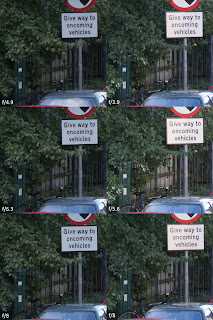
Next test was in the middle of 14-140 range, at its (native) 50mm setting. Curiously Exif reports 92mm equivalent, but FZ1000 reporting 110mm equivalent shows to the same scene borders (I was worried unfair gain due to magnification, but later aperture vs focal length test showed GH4 reports 'bands' rather than actual values). I also set aperture accidentally at f6.3 rather than f5.6 in one case, but here differences between the lenses are even more obvious, so that did not give any advantage.


End of range of 14-140 mm lens is definitely its weakest. Here however FZ1000 at f/4 shows also big loss from its result when stopped down to f/5.6.
FZ1000 can stretch further, to 400mm equivalent focal length, but I downsampled the result and compared with crop from image taken at 300mm, and although I could see the difference, it was very tiny. So this lens also at tele end offers more on paper than there is of actual gain.
All the images are available for pixel peeping: developed from raw with default settings (WB as shot, Sherpening amount 25/ raduis 1.0) in LR5.6, exported to jpeg 90% quality, sharpened for screen standard and resized to 4608px horizontal (do downsample FZ1000 results)
Stabilisation
I compared by shooting burst series handheld. FZ1000 seems to have produced more sharp results. I'm actually impressed that at 300mm 1/25s handheld I could pick a couple of identically sharp photos from a burst series.

Noise
I shot the same scene with FZ1000 at ISO400 and GH4 at ISO800, to test the idea that 1 stop extra of aperture can compensate (or even still keep ahead) FZ1000 shortcoming. I like FZ1000 result more, it seems of lower amplitude and proves gain from downsampling resulting in finer grain. To be honest even with both at ISO800 I could still call a draw, because increased noise amplitude of 1" sensor is partially covered by its finer structure. Note: the images were underexposed and pulled up 2 stops, so the absolute noise amount is closer to ISO1600 and ISO3200 respectively - those cameras aren't that noisy at moderate settings!
Although shot for noise, picture of FZ1000 is noticeably soft (spot focus on the vase in both cases), so I started suspect its lens may be optimised for far distance and struggle with closeups. I did a quick check in room conditions and results at wide again indicate 14-140 to be the loser, but this time it also lost at flower test. I think shiny vase is not great focusing target then...


Macro
FZ1000 is equipped in 'Macro AF' mode. However the way it works allows one to focus as close as 2cm from the lens front at wide angle, but with increasing focal the minimal focusing distance increases even more! That behaviour makes photographing the very close subject pretty much impossible, as there is risk of shadowing as well as scaring (live) subject away, distortion introduced by wide perspective aside. 14-140mm lens is no macro lens neither and produces the biggest magnification at its long end. Here perspective can also get distorted, on top of that lack of sharpness, small aperture and sensitivity to vibration play their roles. In such contest FZ1000 wins at its 45mm setting, where it produces the bigger magnification as frame fill factor and in absolute terms (2950 px height of the model used)
Focusing
With sunlight and in a room at daylight both cameras focused identically - instantly. Unfortunately I did not have chance to carry out any sensible test of continuous AF or tracking capabilities.
In manual focusing mode both cameras offer helpful focus peaking and image magnification, and here one of little differences show again: FZ1000 magnifies up to 6x, GH4 up to 10x.
Read next: Panasonic FZ1000 vs GH4 with 14-140mm f/3.5-5.6 (4): movies
Here are charts comparing lenses' light gathering ability and achievable depth of field (equivalent of full frame aperture setting) as a function of focal length.
In light gathering ability at all focal lenghth FZ1000's lens is constantly nearly 1 stop brighter. At the same time depth of field produced by those lenses wide open is going to be also nearly identical. Mind that FZ1000 lens stops down to f/8 only.
Test procedure
Camera on tripod, IS off, 10s self-timer, base ISO (125 on FZ1000, 200 on GH4), mechanical shutter, aperture priority, the same horizontal angle of view, the same focus point (AF single, spot focus), raw image developed in LR 5.6 with default settings (all sliders at 0, sharpening 25), exported to Jpeg at 90% quality, sharpening to screen - normal, resized to 4608px on long edge (to downsample FZ1000). Crops for side-by-side comparison edited in IrfanView and saved as Jpeg at 90% (different percents than LR) quality. I have no intention nor tools to produce absolute numbers, just naked eye to subjectively judge which of a pair of images looks sharper.
First of all, due to already mentioned different aspect ratios, at given focal length 3:2 frame gives larger horizontal angle of view. In all the tests I tried to frame with the same left-to-right range and the difference of focal length is about 10% (eg 28mm (in 35mm equivalent) on GH4 required 31mm on FZ1000). That way FZ1000 also gains the most, so it is worth to bear in mind.
FZ1000 starts very wide, at 25mm, offering more than 14-140mm lens achieves. It struggles a bit at that setting, with increased chromatic aberrations and slight drop of sharpness (likely result of under-the-bonnet compensation for distortion)
Sharpness
In all side-by-side comparisons GH4 with 14-140mm is on the left, FZ1000 on the right

 |
| Centre - far focus |

 |
| Left - close focus |

 |
| Right - medium focus |
For wide angle I checked left hand side at about 10m distance, right hand side at about 20m and centre at about 50m (focus points marked on scene images). The reason was my typical (landscape like) use of camera. Note that FZ1000 at this setting is already at f/3, only 1/3 stop from 14-140mm initial f/3.5. At all aperture settings Leica glass is sharper, with 14-140 showing visible purple fringing wide open - exactly what affected FZ1000 at its widest. Also when comparing results at 1 stop difference, MFT combo loses.


Next test was in the middle of 14-140 range, at its (native) 50mm setting. Curiously Exif reports 92mm equivalent, but FZ1000 reporting 110mm equivalent shows to the same scene borders (I was worried unfair gain due to magnification, but later aperture vs focal length test showed GH4 reports 'bands' rather than actual values). I also set aperture accidentally at f6.3 rather than f5.6 in one case, but here differences between the lenses are even more obvious, so that did not give any advantage.


End of range of 14-140 mm lens is definitely its weakest. Here however FZ1000 at f/4 shows also big loss from its result when stopped down to f/5.6.
FZ1000 can stretch further, to 400mm equivalent focal length, but I downsampled the result and compared with crop from image taken at 300mm, and although I could see the difference, it was very tiny. So this lens also at tele end offers more on paper than there is of actual gain.
All the images are available for pixel peeping: developed from raw with default settings (WB as shot, Sherpening amount 25/ raduis 1.0) in LR5.6, exported to jpeg 90% quality, sharpened for screen standard and resized to 4608px horizontal (do downsample FZ1000 results)
Stabilisation
I compared by shooting burst series handheld. FZ1000 seems to have produced more sharp results. I'm actually impressed that at 300mm 1/25s handheld I could pick a couple of identically sharp photos from a burst series.

Noise
I shot the same scene with FZ1000 at ISO400 and GH4 at ISO800, to test the idea that 1 stop extra of aperture can compensate (or even still keep ahead) FZ1000 shortcoming. I like FZ1000 result more, it seems of lower amplitude and proves gain from downsampling resulting in finer grain. To be honest even with both at ISO800 I could still call a draw, because increased noise amplitude of 1" sensor is partially covered by its finer structure. Note: the images were underexposed and pulled up 2 stops, so the absolute noise amount is closer to ISO1600 and ISO3200 respectively - those cameras aren't that noisy at moderate settings!
Although shot for noise, picture of FZ1000 is noticeably soft (spot focus on the vase in both cases), so I started suspect its lens may be optimised for far distance and struggle with closeups. I did a quick check in room conditions and results at wide again indicate 14-140 to be the loser, but this time it also lost at flower test. I think shiny vase is not great focusing target then...


From the left: FZ1000@ 25mm (equiv), FZ1000@ 45mm , 14-140 mm @ 280mm (E)
All crops from landscape.
Macro
FZ1000 is equipped in 'Macro AF' mode. However the way it works allows one to focus as close as 2cm from the lens front at wide angle, but with increasing focal the minimal focusing distance increases even more! That behaviour makes photographing the very close subject pretty much impossible, as there is risk of shadowing as well as scaring (live) subject away, distortion introduced by wide perspective aside. 14-140mm lens is no macro lens neither and produces the biggest magnification at its long end. Here perspective can also get distorted, on top of that lack of sharpness, small aperture and sensitivity to vibration play their roles. In such contest FZ1000 wins at its 45mm setting, where it produces the bigger magnification as frame fill factor and in absolute terms (2950 px height of the model used)
Focusing
With sunlight and in a room at daylight both cameras focused identically - instantly. Unfortunately I did not have chance to carry out any sensible test of continuous AF or tracking capabilities.
In manual focusing mode both cameras offer helpful focus peaking and image magnification, and here one of little differences show again: FZ1000 magnifies up to 6x, GH4 up to 10x.
Read next: Panasonic FZ1000 vs GH4 with 14-140mm f/3.5-5.6 (4): movies
Subscribe to:
Posts (Atom)